Literary FictionePub
Valley of Dry Bones

Author
Fatima al-Rashid
Share
About this book
On the banks of the Chebar Canal, five years into the Babylonian exile, the priest Ezekiel ben Buzi receives a vision that conscripts him as prophet to a community that does not want prophecy. Fatima al-Rashid's epic of sixth-century BCE Mesopotamia traces the slow cost of a calling — measured in dust, in shaved hair, and in the quiet erosion of a marriage.
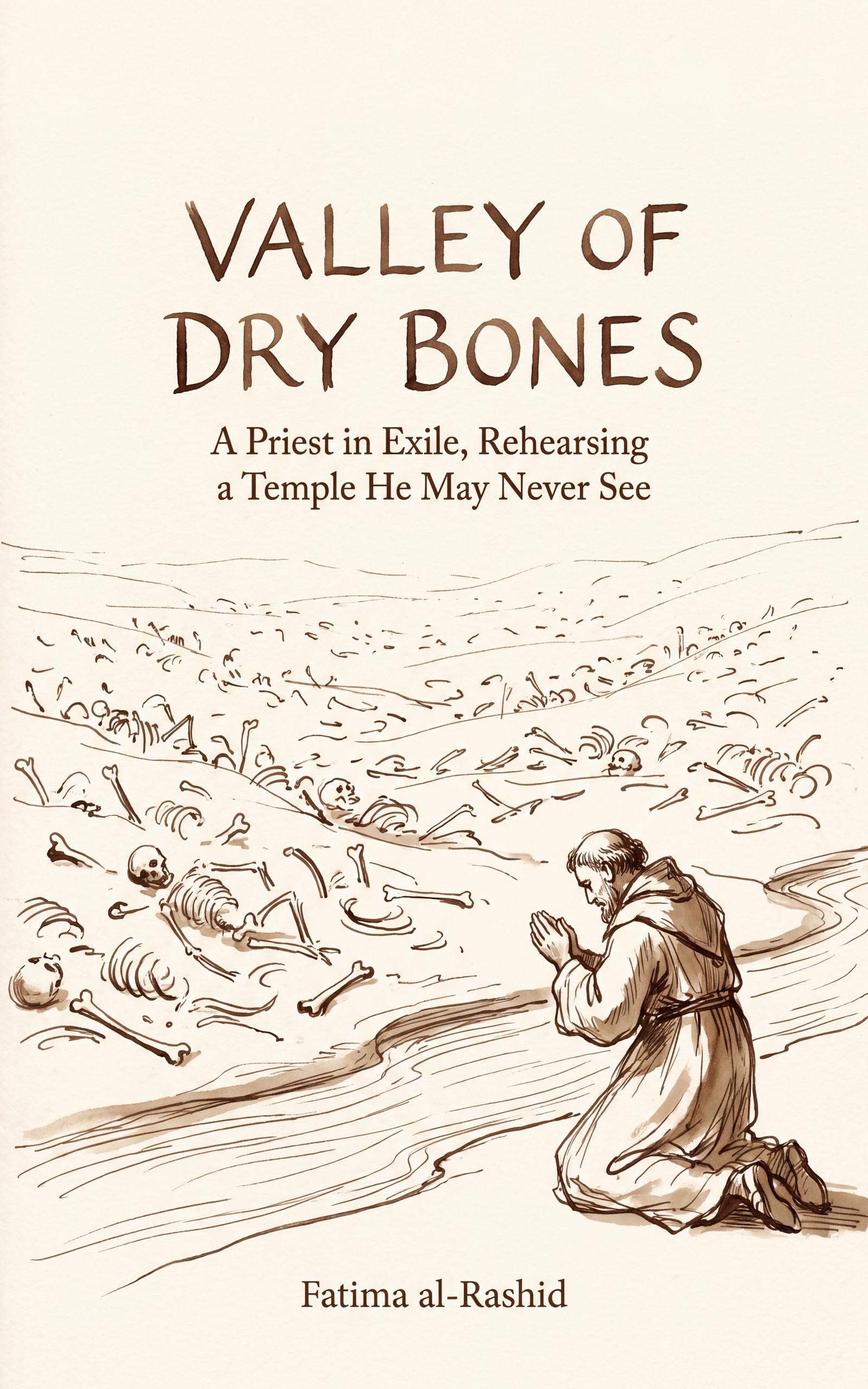
Predawn on the Chebar Canal. A priest kneels at the water's edge, performing the ablutions of a Temple he may never see again, his hands trembling as they have trembled since the soldiers came. Around him, forty goat-hair tents sag in the dust. On the horizon, the blue tiers of Babylon catch the first light, obscenely beautiful.
For the exiles of Judah, survival is its own slow erosion. The elders weigh Babylonian land against Babylonian sons; the children no longer remember the Temple; a man in a faded crimson cloak walks alone to the water and is gone, somewhere the rest of them cannot follow. When Ezekiel ben Buzi returns from his vision of wheels and eyes and burnished bronze, he returns as something his wife Miriam did not marry.
What follows is a calling lived out in the dirt of a refugee camp — a clay-tablet city besieged in miniature, three hundred and ninety days lying on one side, a priest's own shorn hair divided to fire, sword, and wind. Each act of obedience costs him standing in the community, and costs Miriam the small, ordinary marriage she had carried out of Jerusalem in a woven belt of blue and crimson thread.
Fatima al-Rashid's novel asks what is left of a people, a marriage, and a man when the God who speaks of nations refuses to speak of one tent by a canal.
“This is storytelling on a grand canvas, painted with the fine brushstrokes of a literary master.”
— Sebastian Moreau, author of The Pied Piper★★★★☆