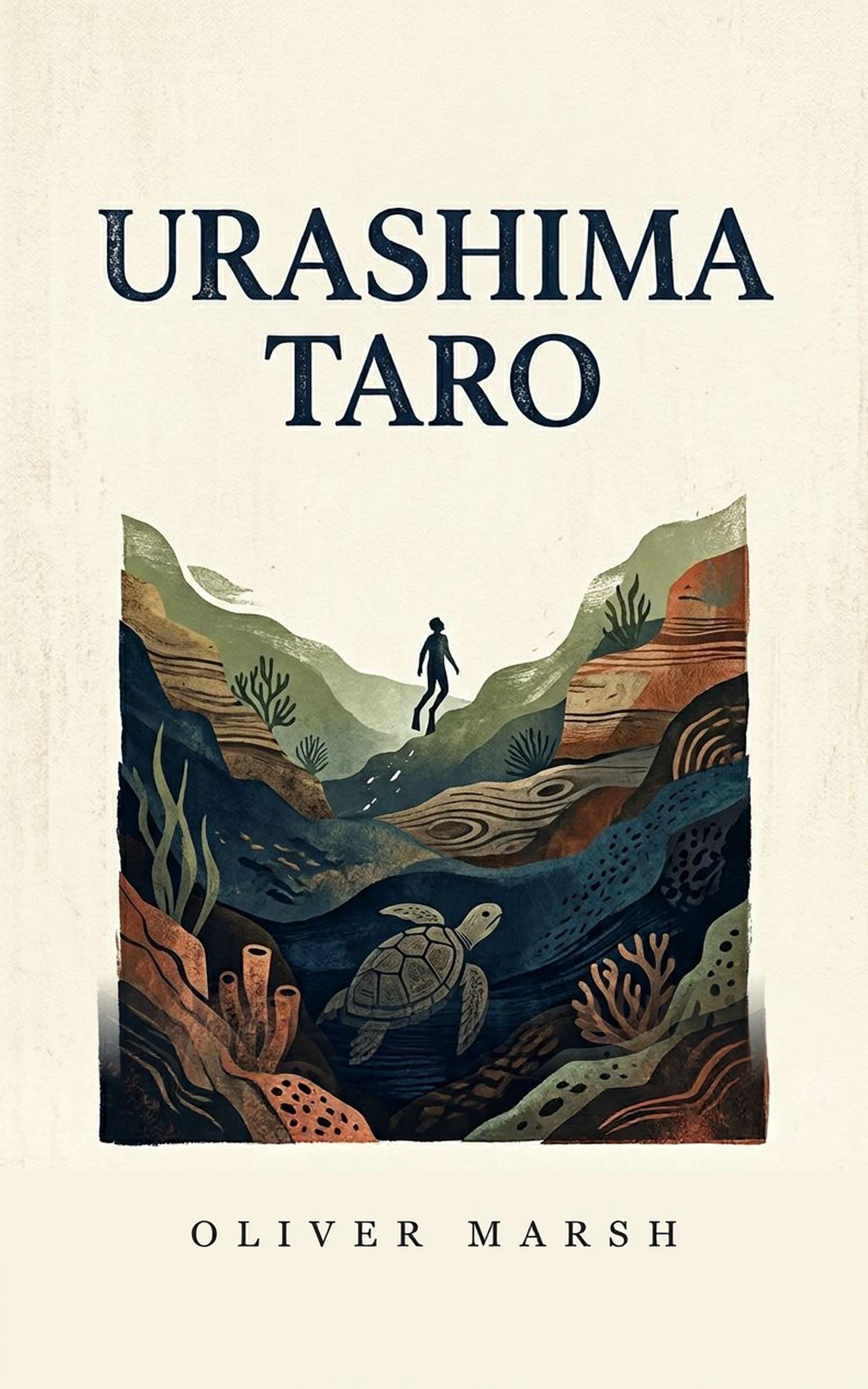
Urashima Taro

Author
Oliver Marsh
Share
About this book
A marine biologist descends alone to the floor of the Mariana Trench for a seventy-two-hour research mission and surfaces three centuries later, into a quieter, depopulated world that has chosen to release its memory of the past. Reworking the Japanese legend of Urashima Taro, Oliver Marsh's debut science fiction novel is a meditation on grief, distance, and the ethics of remembering.
At 10,900 meters, the bottom of the Mariana Trench glows like a sky turned inside out. Dr. Kenji Murakami descends into it alone, sealed inside an experimental habitat for seventy-two hours of geological sampling and quiet, meticulous work — the kind of work he has always preferred to the human kind. Before he leaves the surface, his brother Kai asks him not to go. He goes anyway.
Three days later, Kenji surfaces onto a beach he does not recognize. The coastline is wrong. The sky is the wrong color. A young stranger named Ren approaches across the sand and tells him, gently, that three hundred and twenty-three years have passed. The world he left is gone — not destroyed, exactly, but winnowed, then quietly relinquished by the survivors in a generational act they call the Letting Go.
In the settlement of Tango Shore, Kenji is a man from the Before, walking through the grief he never let himself feel for a brother now centuries dead. He carries with him a sealed black case the architect of his mission pressed into his hands — a quantum archive he was instructed not to open until he surfaced.
What is inside has been waiting for him, and for the amnesiac descendants of his species, for three hundred years. Drawing on the old folktale of the fisherman who returns from the sea kingdom to a world that has forgotten him, Oliver Marsh's novel asks what we owe to the dead, and whether some inheritances are gifts or burdens.
“Speculative fiction at its most provocative. The future it imagines feels uncomfortably close to the present.”
— Marcus Chen, author of Syndrome K★★★☆☆