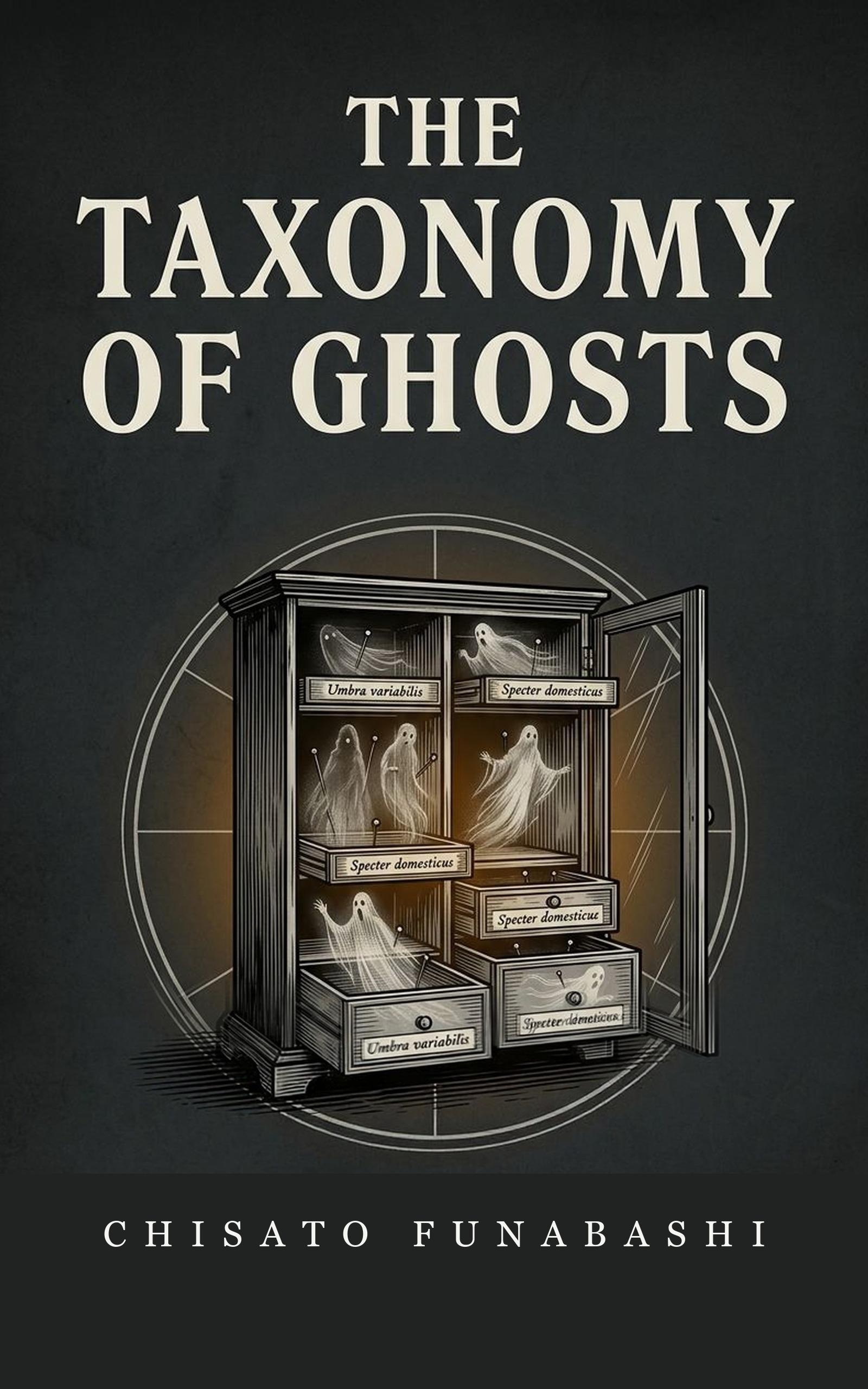
The Taxonomy of Ghosts
Author
Chisato Funabashi
Share
About this book
In a sepia-toned Victorian London, the foremost classifier of ghosts confronts a phenomenon that resists her instruments: an entity that grows stronger with every act of disbelief. Chisato Funabashi's debut moves between mother and daughter, scientist and assistant, charting the architecture of a household built on what its inhabitants have agreed not to see.
At fourteen Marchmont Street, behind shuttered windows in gaslit Bloomsbury, Dr. Cordelia Voss labels the dead. Bell jars hum with cobalt residue. Phonograph cylinders preserve the murmurs of forty-year-old housemaids. Eight hundred and forty-seven species, catalogued in fourteen hundred pages, dismissed by the Royal Society as fever dreams in fairy stories. Her assistant Aldous Finch, eleven years immaculate and unaging, brings the morning post and the afternoon tea.
Then the skeptics begin to die. A debunker collapses mid-lecture as cobalt light pours from his chest. A newspaper editor goes silent at his desk. A chemist is found bleached pale among his exposed plates. Each death attends the precise moment of denial. Cordelia's instruments record an absence rather than a presence — a hole in the world shaped like the conviction that ghosts cannot exist.
Into this cold geometry walks Helena, the daughter Cordelia raised among specimens and lost to the séance trade. Helena sees what her mother has trained herself not to: that taxonomy has its blind spots, that some classifications are kept open as acts of mercy, and that the entity feeding on London's rationalism may be unkillable precisely because to disprove it is to confirm it.
A novel about the cost of seeing clearly, the small dishonesties that hold a household together, and what a scientist owes the things she has chosen never to name.
“Fantasy worldbuilding of the highest order, populated by characters complex enough to inhabit it.”
— Lena Eriksson, author of The Ice Maiden★★★★★