Literary FictionePub
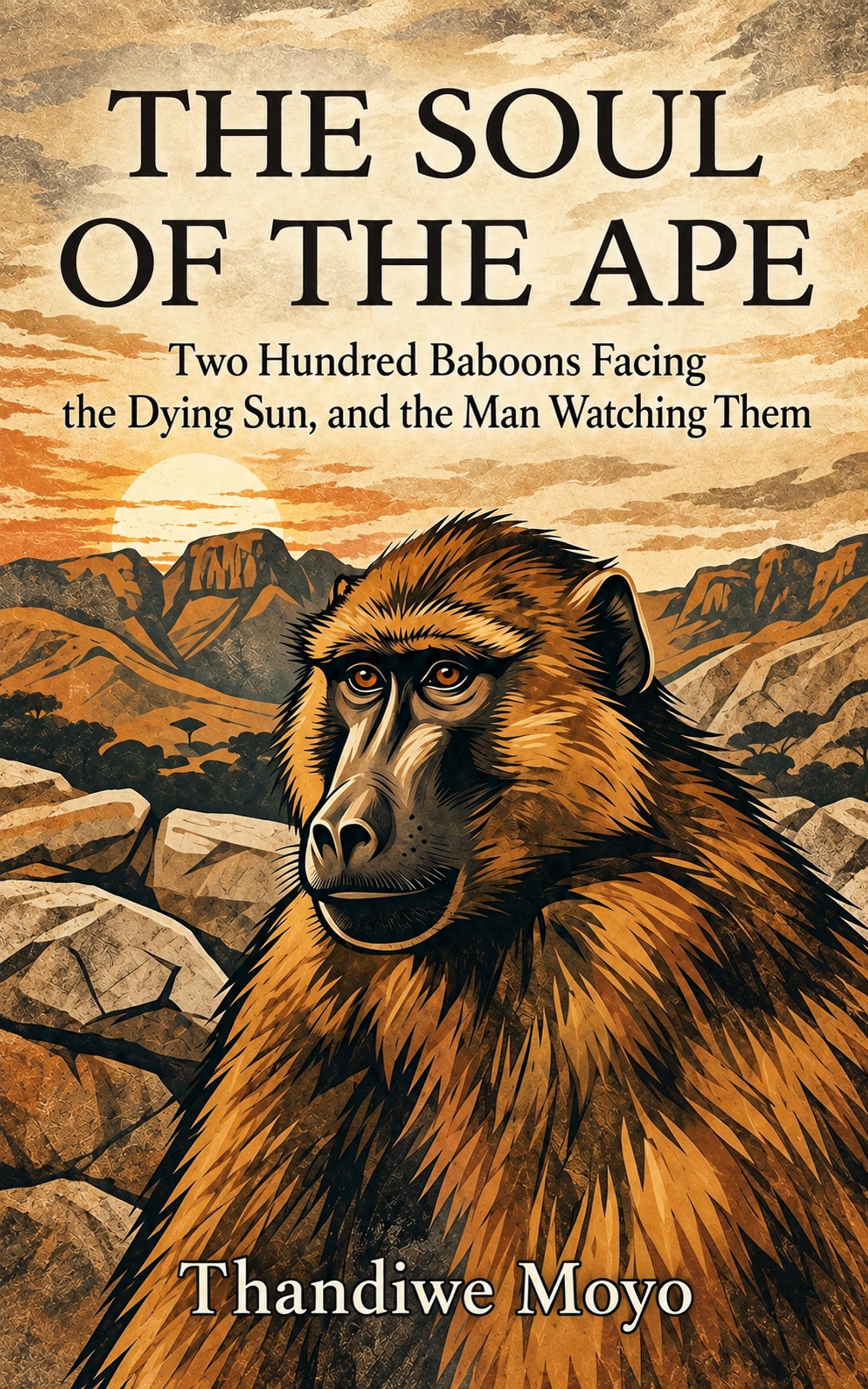
The Soul of the Ape

Author
Thandiwe Moyo
Share
About this book
A drama of obsession, addiction, and intellectual theft set against the sandstone cliffs of the Waterberg. In 1907, an Afrikaner poet and morphine user becomes the first person to live among wild baboons, recording a troop's politics and grief while his own life unravels — and while, an ocean away, another man prepares to take credit for what he is seeing.
Dusk on the Waterberg escarpment. Two hundred chacma baboons sit motionless on a sandstone ledge, facing the dying sun with expressions a careful observer might call sorrow. Eugène Marais — Pretoria lawyer, newspaperman, poet, widower, morphine addict — has come north to watch them. He believes consciousness did not begin with humans, and that the troop above his tent will prove it.
In 1907, no one has yet lived among wild primates. With a young naturalist for a companion and a leather kit beside his cot, Marais climbs the cliffs each dawn and waits. He names the alpha male, the orphaned juvenile, the old female who chooses to mother her. He records grief, politics, intoxication, the hesitation hour at sundown. He is writing the first ethology of a wild primate troop, and he is writing it in Afrikaans, in a country that has just lost a war.
Far away, a Belgian Nobel laureate is reading translations.
What Marais finds in the bushveld is not consolation. It is recognition — the bearing of the deposed alpha, the young male who returns each day to the marula tree, the ape who cannot stop knowing that he exists. The question the mountain asks him is whether a man who has watched compassion appear between two animals can find it in time for himself.
“Whose discovery is it, the man who lived it or the man who published it? Between baboon grief and morphine, the novel keeps its central theft in devastating focus.”
— Anastasia Volkova, author of The Magic Swan Geese★★★★☆