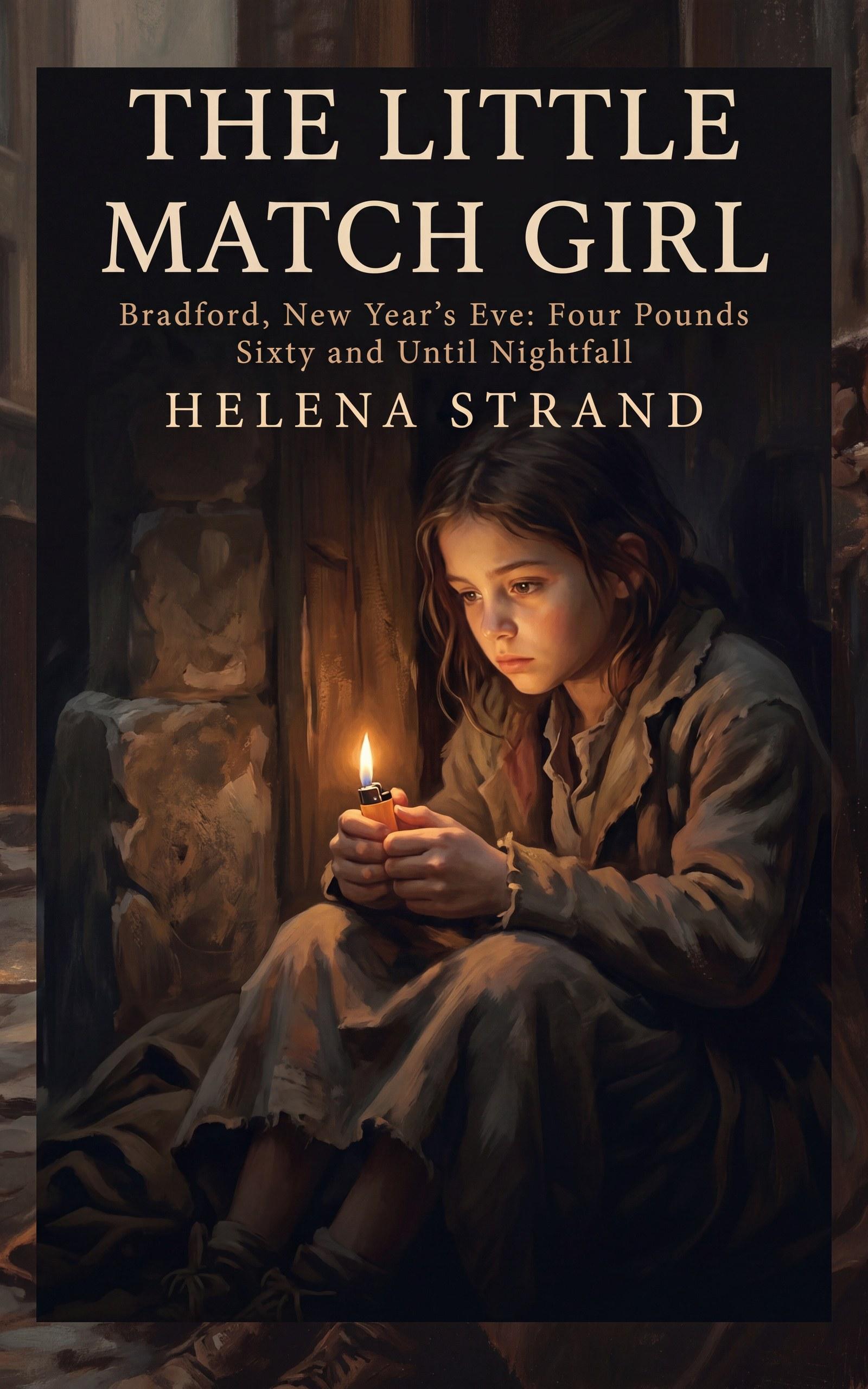
The Little Match Girl

Author
Helena Strand
Share
About this book
On New Year's Eve in Bradford, twelve-year-old Ileana, trafficked from Romania and held to a nightly begging quota, walks the freezing city looking for thirty pounds and a way to stay warm. Helena Strand traces a single afternoon and evening through the eyes of a child the system briefly notices and lets go.
On the last evening of the year, the wind cuts through Bradford's emptying streets, finding every gap in Ileana's two thin hoodies. She is twelve. She has four pounds and sixty pence in a paper coffee cup, a misspelled cardboard sign, and until nightfall to make thirty pounds — Vasile's quota, applied without anger, the way a shopkeeper closes a till.
Trafficked from a Romanian orphanage and housed in a terraced room in Manningham, Ileana is one of five children Vasile feeds, shelters, and sends out to beg. The arithmetic of her evening is impossible. The city, gathering itself for New Year's Eve, is full of faces that look away, film her, lecture her, ask why she doesn't get a job. A volunteer offers a phone call she cannot accept. A woman in a hurry presses a ten-pound note into her cup and walks on.
Helena Strand follows the child through a single Yorkshire night, mapping the small refusals — of strangers, of charities, of policies written for someone else's emergency — that accumulate into a death no one quite witnesses. The novel asks not why Ileana was failed, but how a city can contain her and never see her at all.
A quiet, exact reckoning with the spaces between unkindness and employment, where children fall.
“Thirty pounds short on a freezing New Year's Eve, seen and released by every system meant to catch her. It made me furious, then ashamed, in that order.”
— Samuel Osei, author of Sundiata★★★★★