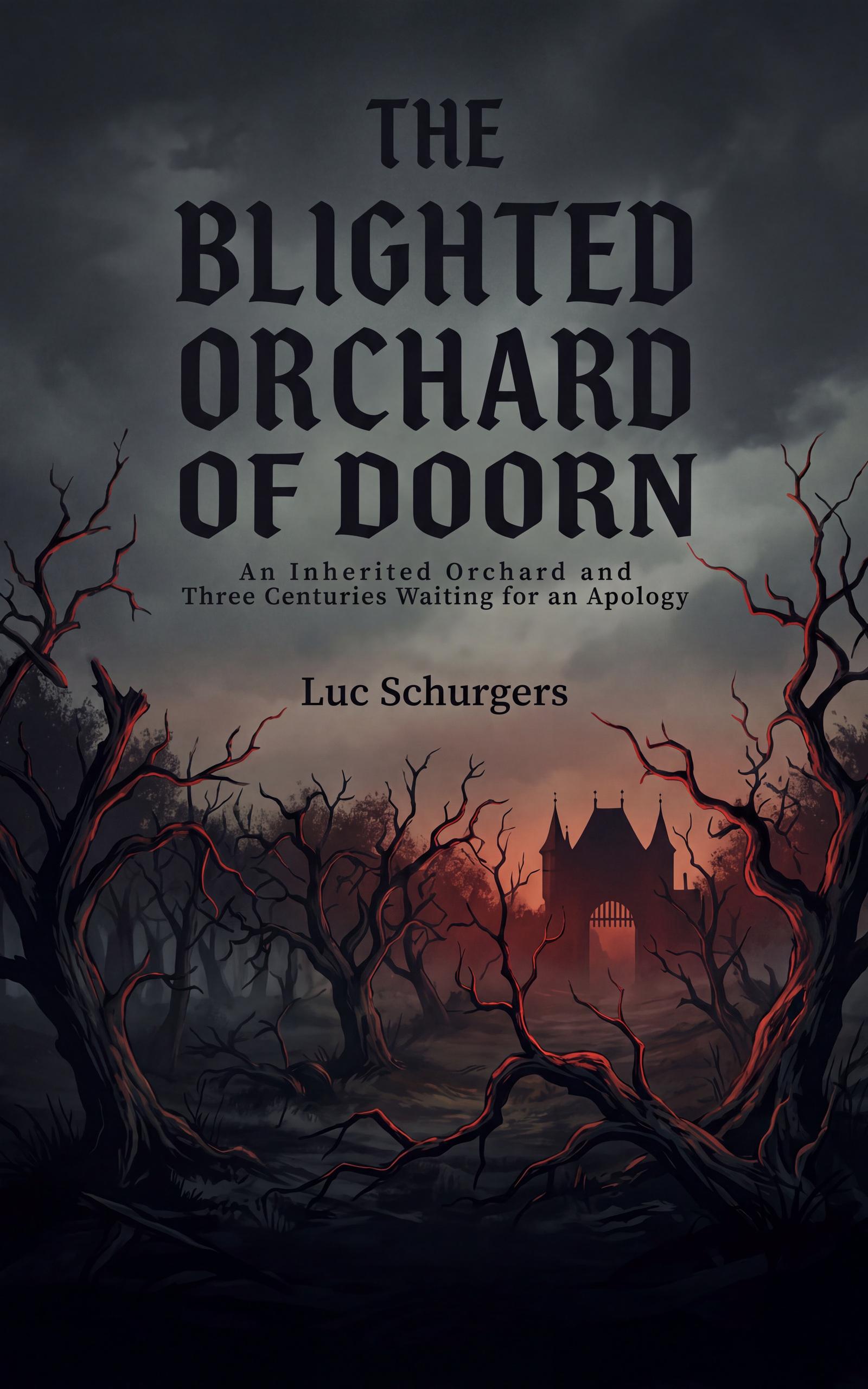
Folk HorrorePub
The Blighted Orchard of Doorn

Author
Luc Schurgers
Share
About this book
An Amsterdam urban planner inherits a barren orchard in the Dutch village of Doorn, where the south field has no birdsong and the villagers are warmly, immovably silent on the subject of her family's land. Drawing on the close interiors of Dutch Golden Age painting and the patient grammar of folk horror, Luc Schurgers's novel traces a three-century debt back to the blood that owes it.
The south field of the van Houten property has no birds. Lena hears it before she understands it — a held silence where the lane outside the hedge carries thrushes and dogs and the clatter of cafe plates. She has come from Amsterdam, where her work as an urban planner deals in measured things, to claim an inheritance she did not know existed: an orchard in the village of Doorn where, for three centuries, nothing has thrived.
The villagers are kind. They refill her coffee. They do not finish certain sentences. The contractor will not give an estimate on the south field. A child walks the property at dusk speaking to an apple tree as though to someone seated beneath it. Lena begins to lose hours, then days, then the ordinary geometry of light in a room.
What happened on this land in 1742 is known to Doorn, and has been known, and has never been spoken aloud to an outsider. The debt is not the village's to name. It belongs to the van Houten blood — and Lena, returning, has asked.
Luc Schurgers's novel works in the close, lit interiors of Dutch painting and the long quiet of folk horror, where hospitality and exclusion are the same gesture, and where some inheritances are owed before they are understood.
“Rituals, rural dread, and the terrible weight of tradition. A folk horror novel that tastes of soil and blood.”
— Isabella Rossi, author of La Maupin★★★★☆