Literary FictionePub
Tassili
Author
Gabriel Okonkwo
Share
About this book
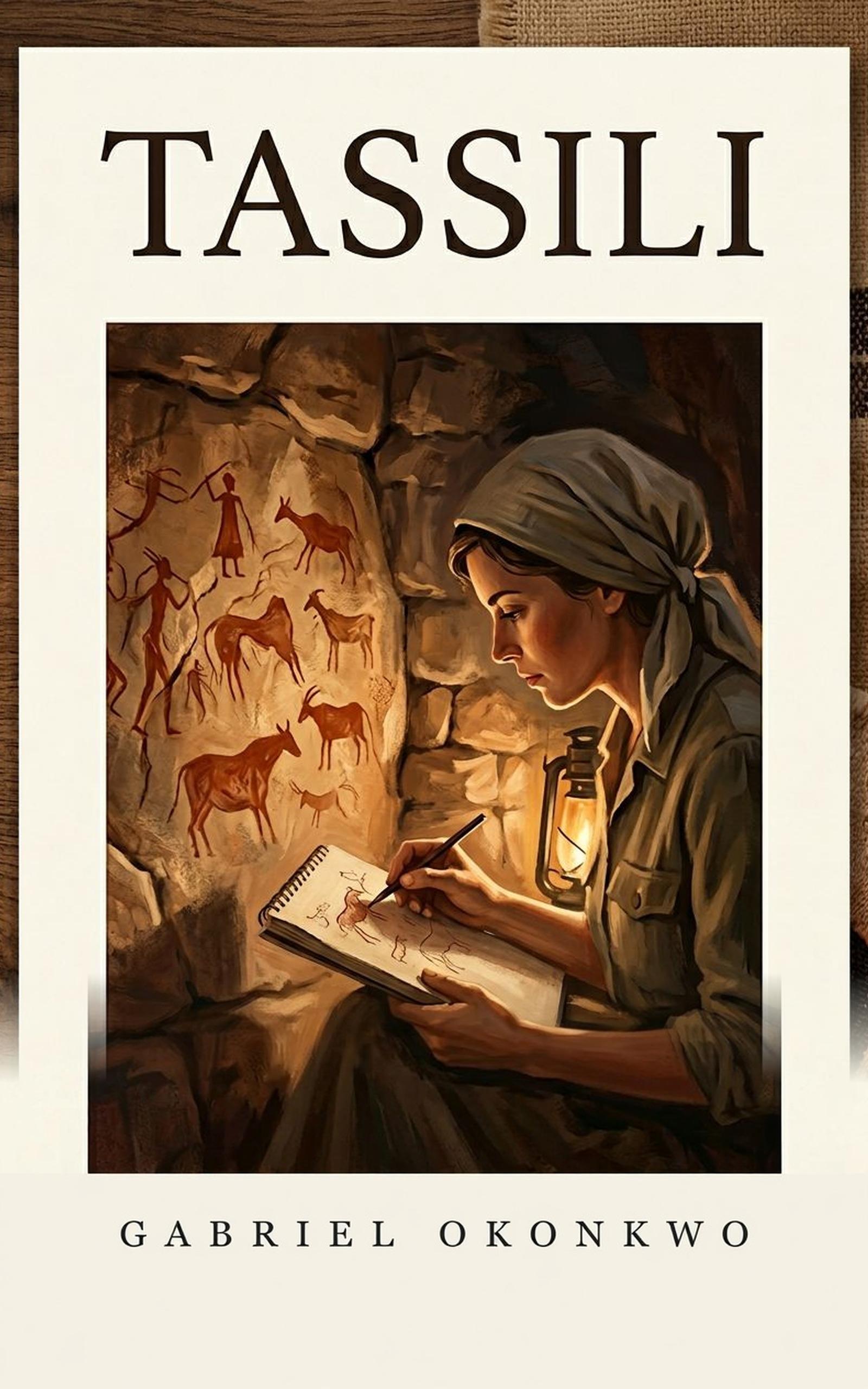
From a Paris sickroom in 1990, the disgraced French ethnographer Henri Lhote tells the story of his 1956 expedition to copy the prehistoric paintings of the Tassili plateau — and of the sponge, and the water, and the catastrophe that followed. Gabriel Okonkwo's novel is a study of obsession, colonial science, and the cost of seeing clearly.
In a Paris apartment thick with cigarette smoke and yellowing photographs, an old man clicks on a tape recorder. It is 1990. Henri Lhote, eighty-seven, has spent four decades being celebrated and condemned for the same act: leading the largest expedition ever mounted to the Tassili plateau in the Algerian Sahara, where fifteen thousand prehistoric paintings span ten thousand years of a vanished green world.
A young Algerian-French journalist arrives at his door. She has stood in the shelters herself. She has seen the dark rectangle where the varnish was tested, the faded ghosts on the rock, the watercolor copies hanging in French museums in colors so vivid they look like stained glass. She has come to ask him a question he has been refusing to answer for thirty-four years.
Moving between the Paris winter of 1990 and the brutal ascent of 1956 — the committee that nearly denied him, the wife who waited sixteen months, the Tuareg guide who watched the Frenchmen unpack their sponges — Gabriel Okonkwo reconstructs an obsession that produced one of the great archives of the twentieth century and one of its great acts of destruction.
What does it mean to save something by changing it? Whose memory is the desert, and whose is the painting on its wall? Tassili is a novel about reverence, ambition, and the line, finer than a brushstroke, between rescuing the past and erasing it.
“This deathbed confession never begs forgiveness. The damage done in the name of seeing clearly is laid out plainly, and the plainness is what devastates.”
— Hallvarður Grímsson, author of Jormungandr★★★★☆