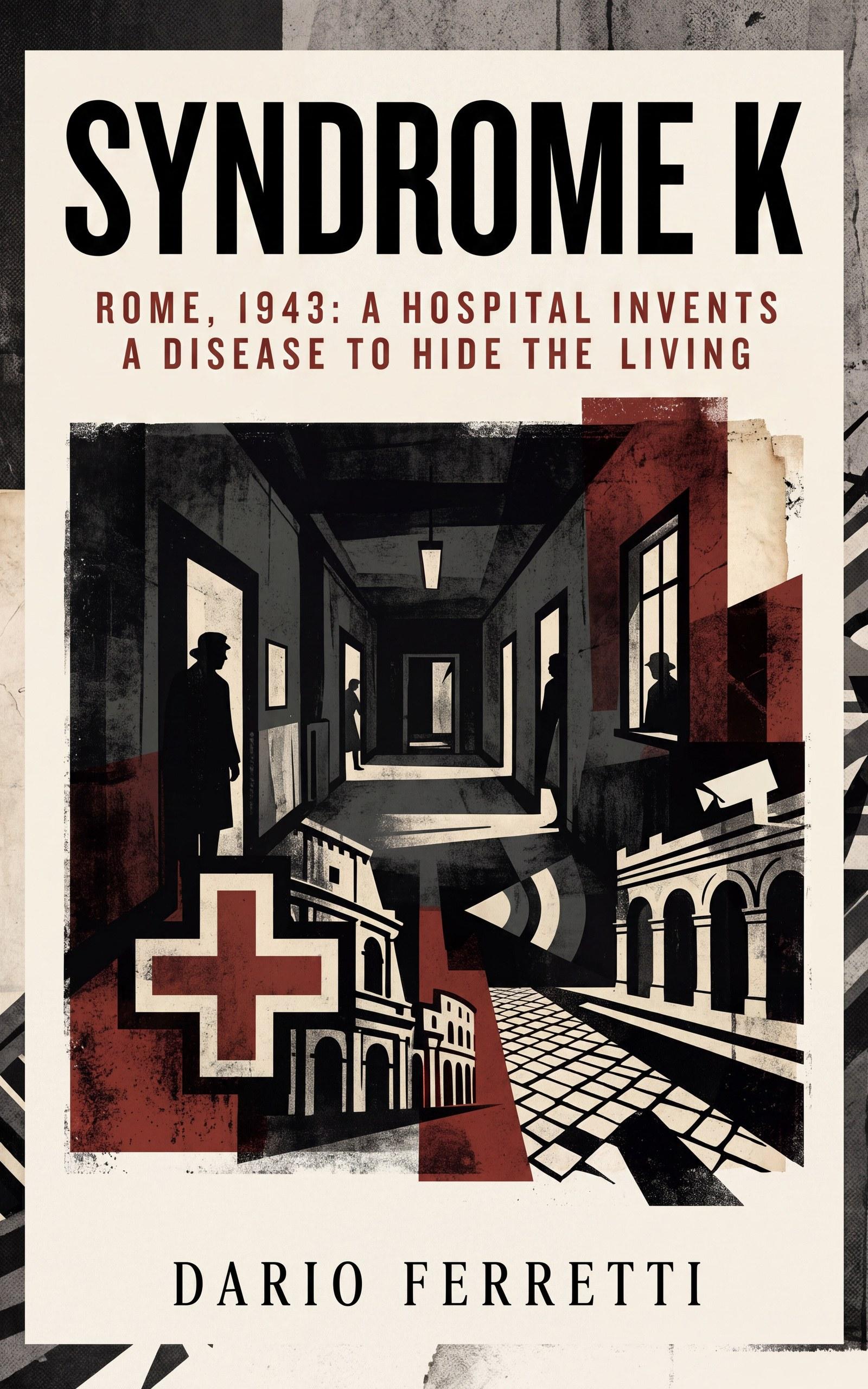
Syndrome K
Author
Dario Ferretti
Share
About this book
October 1943. As the SS prepare to seal the Roman Ghetto, three doctors at the ancient Fatebenefratelli Hospital on Tiber Island invent a fictitious disease — Syndrome K — to disguise Jewish refugees as quarantined patients. Dario Ferretti's historical novel reconstructs the improvised sanctuary day by day, attentive to the medicine, the language of occupation, and the moral arithmetic of resistance.
Pre-dawn over the Tiber, October 1943. A man crosses the Ponte Fabricio carrying a sleeping child, not looking at the water, looking only behind him. From a third-floor window of the Fatebenefratelli Hospital, Dr. Giovanni Borromeo watches him come, as he has watched every morning for weeks.
Rome is occupied. The SS have set the date for the mass roundup of the city's Jewish community — a community Roman since before the Colosseum. Inside the hospital on Tiber Island, three doctors prepare what may be the only sanctuary left. Borromeo, devout and watchful. Vittorio Sacerdoti, who signs the ward register each morning under a name that is not his own, his real identity taped inside a copy of Gray's Anatomy. Adriano Ossicini, partisan by night, physician by day, two people in one body.
With hours to spare, they invent a disease. Syndrome K — named, with terrible wit, for Kesselring and Kappler — is highly contagious, invariably fatal, and entirely fictional. Refugees become patients. A lie becomes a quarantine ward. The Germans, when they come, will be afraid to enter.
Dario Ferretti's novel moves through stone corridors and candlelit wards with the patience of a witness, asking what conscience requires of ordinary people when the state turns murderous, and what it costs to keep a ruse alive one bed, one diagnosis, one cough at a time.
“Period detail that never overwhelms the human drama at its center. Historical fiction at its best.”
— Rafael Santos, author of The Planter★★★★★