Literary FictionePub
Signal Loss

Author
Constance Delacroix
Share
About this book
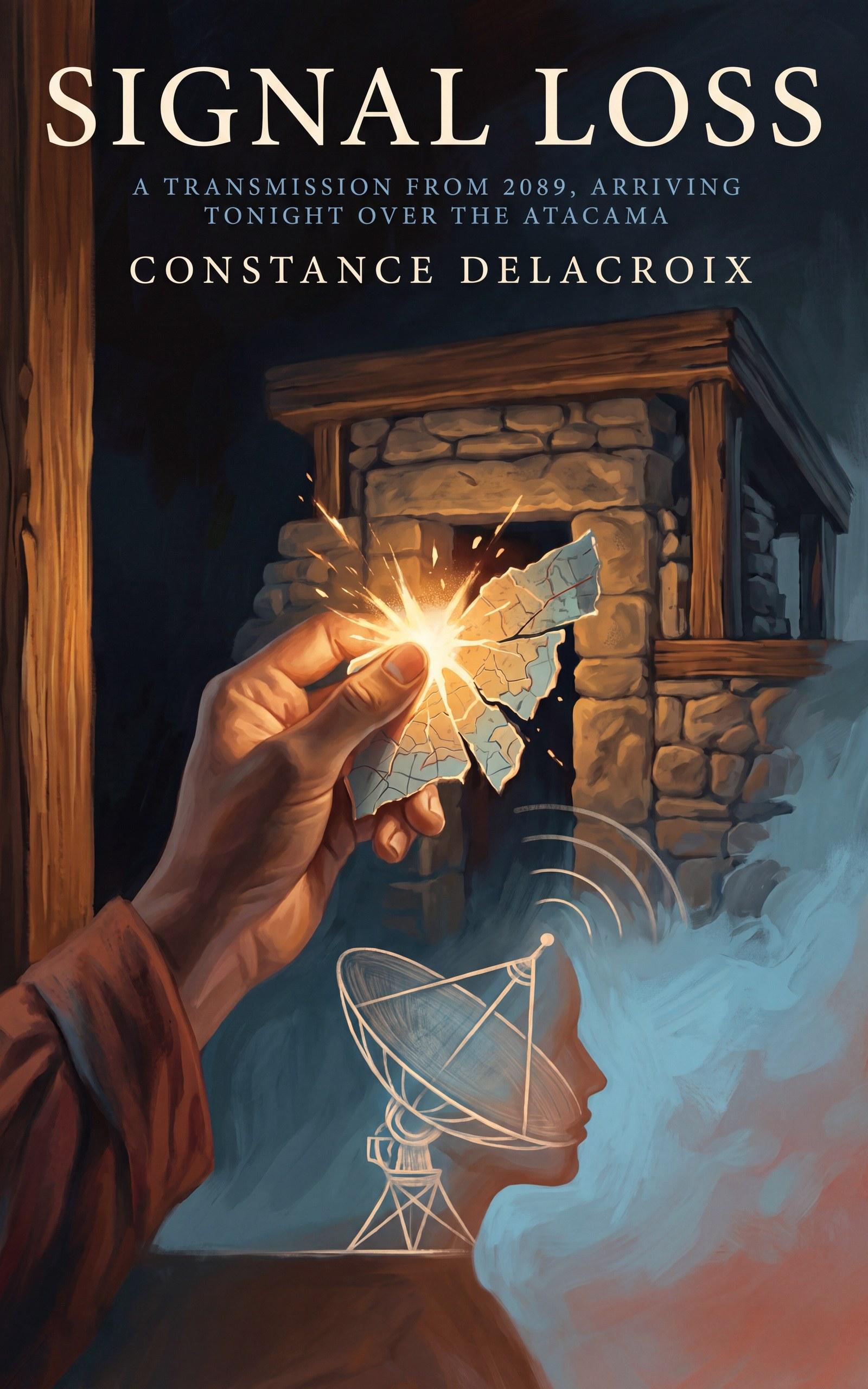
In 2031, scientists at a remote Atacama listening array intercept a transmission from 2089 — a detailed warning of a global catastrophe and a protocol to prevent it. Constance Delacroix's novel follows the small team tasked with deciding whether to obey a future that may unmake itself in the obeying, and what such knowledge costs the people who carry it.
High above the Atacama Desert, where the air is thin enough to hear the universe breathing, the dishes of the ADSA array catch something that should not exist: a transmission from Earth, dated 2089, sent backward through time.
The message carries news bulletins, private letters, and a precise accounting of a catastrophe called the Cascade — 2.3 billion dead — alongside a forty-seven-step protocol said to prevent it. For Dr. Elena Vasquez, who has spent a lifetime being the cleverest person in any room, the signal is the first intelligence she cannot outpace. For Colonel James Ward, it is an order. For the philosopher Amir Hassan, it is a question older than physics: when does prediction become proof, and when does proof become permission?
As the team begins to act on instructions whose consequences they cannot yet see, the signal itself begins to weaken. Each layer Constance Delacroix peels back reveals something more intimate — a sub-channel, a personal message, a future self speaking in a voice the present self does not recognize. Director Lin Chen, who has carried this secret for twelve years, can no longer pretend not to know.
Constance Delacroix's novel is a patient, exacting drama about the feedback between fear and consequence, and about the people who must decide, in the desert silence, whether listening to the future is the same as obeying it.
“Dread by committee: a warning from 2089 handled not as spectacle but as procedure, and the cost of carrying such knowledge is written into every careful page.”
— Frederick Saxby, author of The Nine Hundred and Eighteen★★★★★