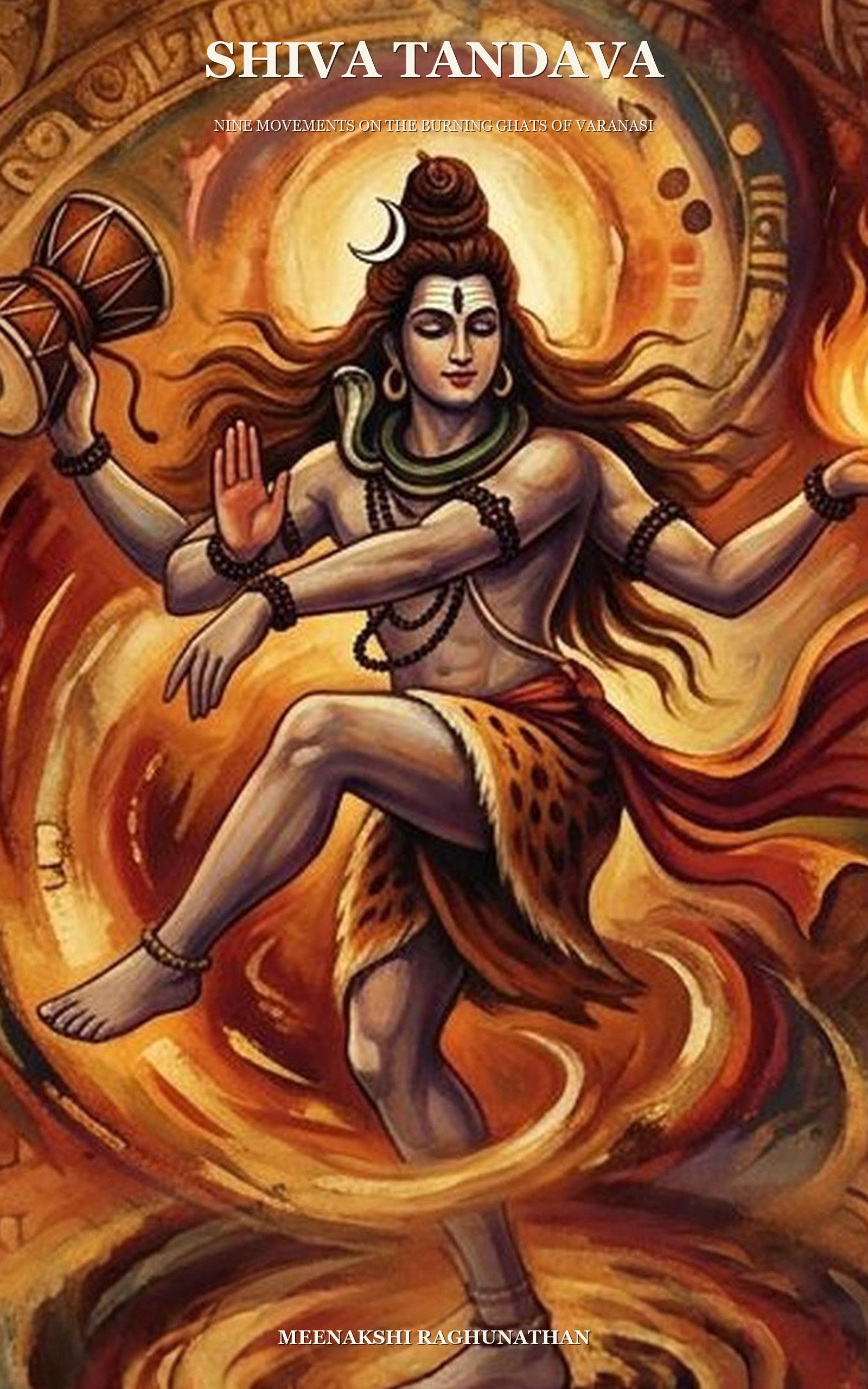
Shiva Tandava

Author
Meenakshi Raghunathan
Share
About this book
From Meenakshi Raghunathan, a sacred narrative in nine movements set in Varanasi, where the daily activity of fire, river, and stone enacts the logic of Shiva's cosmic dance. Composed of long-held scenes, witnessed light, and the city's own sound, the novel attends to creation and destruction as a single ongoing event, holding duration itself as its principal subject.
Before sunrise, on a stone step worn ten centimetres deep by three thousand years of feet, a man releases ash into a river that has carried ash for as long as anyone has counted. He does not look up. He has done this ten thousand times.
In Varanasi, where fire and river and stone hold an unbroken conversation, Meenakshi Raghunathan sets down a work that does not narrate the cosmic dance of Shiva but inhabits it. Across nine movements — from the amber threshold of pre-dawn to the absolute dark inside a crack in ancient stone — the prose holds still while the world moves through it. A garland-maker's hands. The aarti heard from upstream. A monkey on a pillar. The pyres at three in the morning. Each held long enough that duration itself becomes the subject.
The Tandava is not a story to be told but a condition to be witnessed: creation and destruction as a single ongoing event, time as the medium through which the dance moves rather than the axis on which it travels. Sharma asks what prose can do that no other form can — what it means to be present at the scale of a mortal body, at ground level, before something that does not begin or end.
A work in the lineage of Reggio and Tarkovsky, written in light, water, ash, and patience.
“Nine movements of fire and river, with no plot to hide behind — just Varanasi enacting creation and destruction at once. I came away quieted, almost rearranged.”
— Sofía Estrada, author of The Body and the Brush★★★★★