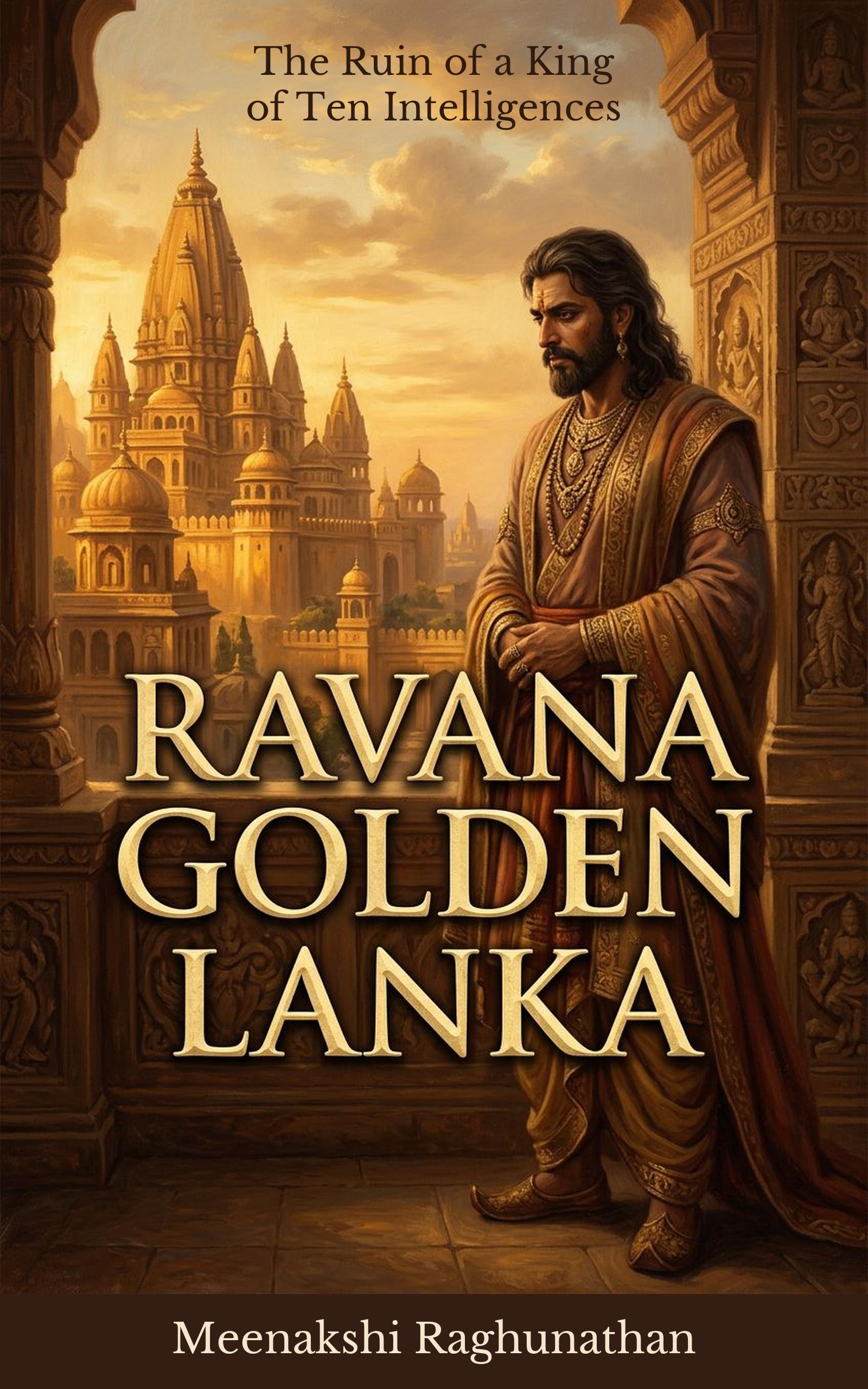
Ravana Golden Lanka
The Ruin of a King of Ten Intelligences

Author
Meenakshi Raghunathan
Share
About this book
Meenakshi Raghunathan reimagines the Ramayana from the throne of its antagonist: Ravana, scholar-king of Lanka, master of the four Vedas, architect of a golden city, who abducts the wife of a mortal prince and watches the most magnificent civilization on earth burn for it. An interior epic of pride, intelligence, and inevitability, told as chamber tragedy while the war unfolds beyond the palace walls.
At dawn, the towers of Lanka catch light in sequence from east to west, gold over granite, a single flame igniting across the greatest city the ancient world has ever built. Inside its walls live the largest library ever assembled, music finer than any age has produced, and a king of ten intelligences who has been right about everything for ten thousand years.
Then his sister returns from the forest, disfigured. Ravana asks her to describe the wife of the mortal prince Rama. He goes to Panchavati. He takes her. He places her in the Ashoka grove with every honor and asks her to choose him. She refuses with the certainty of a woman who already knows the outcome and has decided to be it.
In the daily silence of the grove, in the warnings of his queen Mandodari, in the counsel of his righteous brother Vibhishana, Ravana hears every reason to undo what he has done. He understands all of it. He does not act. Beyond the palace walls, an army gathers. A bridge rises across the southern ocean, stone by stone, each one inscribed with Rama's name.
Told from the throne room while the war moves offscreen — through smoke, through messengers, through the quality of light changing from amber to red — Meenakshi Raghunathan's novel asks what it costs a civilization when its greatest mind chooses pride over survival, and renders the most magnificent catastrophe in world mythology from inside the catastrophe.
“Watching a brilliant king reason his way toward ruin hurts precisely because you understand each step. Pride has rarely felt this intimate, or this doomed.”
— Miriam Sato, author of Shrenika Fate★★★☆☆