Sci-FiePub
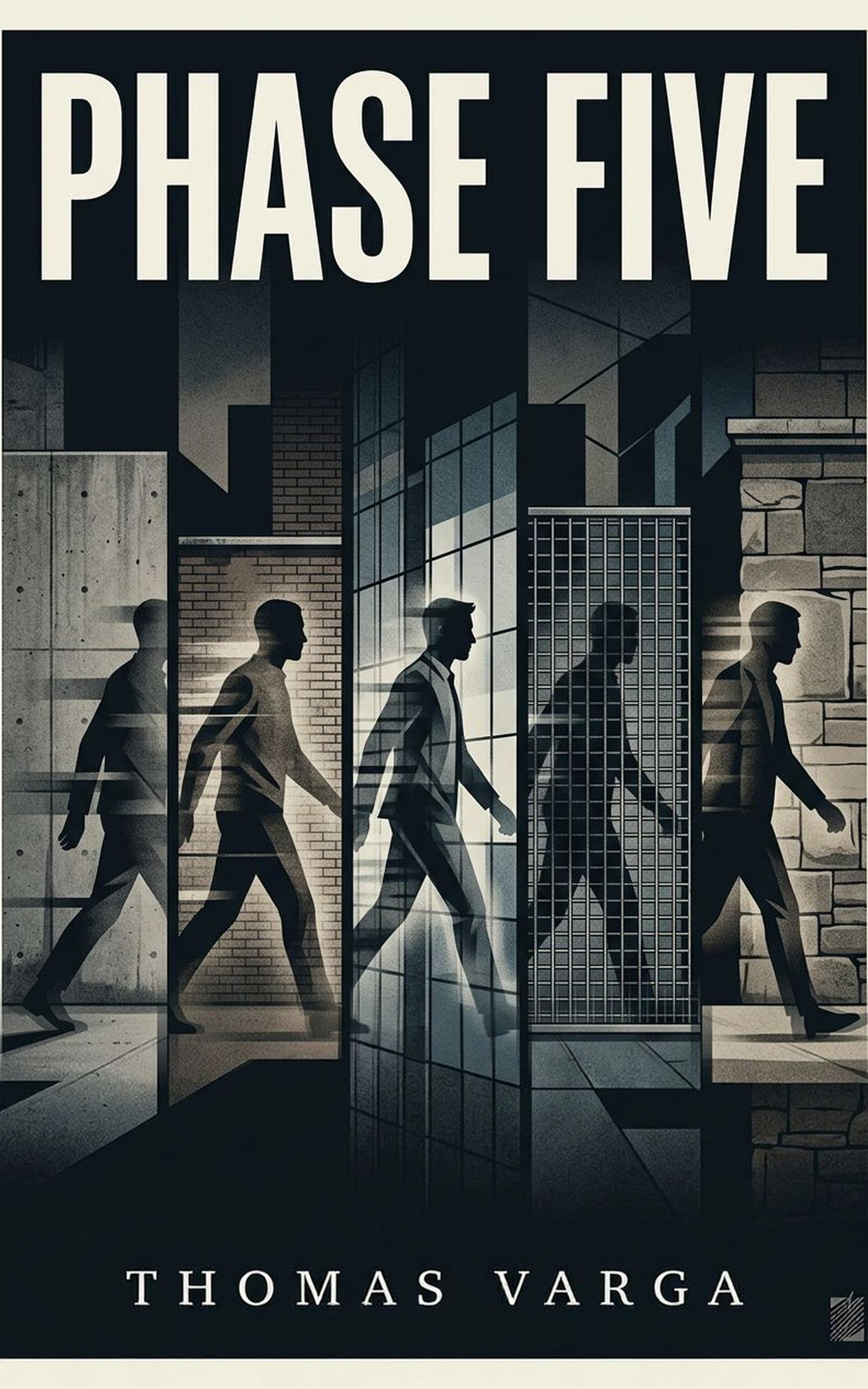
Phase Five

Author
Thomas Varga
Share
About this book
A satellite over the Gulf of Guinea registers five simultaneous gravimetric pulses, one on each inhabited continent. Five strangers wake to find they can move through solid matter — but only in narrow windows when all of them are awake at once. Hunted across sixteen time zones by a covert unit called PALE ARCHIVE, they must learn to coordinate their waking hours by phone before one of them sleeps.
At 03:14 in Lagos, a man's hand passes through his bathroom wall to the wrist. Ninety minutes later, in a Kolkata operating theatre, an anesthesiologist's elbow sinks two inches into a heart monitor while her hands are inside a stranger's airway. By dawn, in Auckland, Stavanger, and São Paulo, three more lives have quietly come unmoored from the laws of solid matter.
They have never met. They share no language, no continent, no hour of the day. But the rule that governs their new condition is unforgiving: they can move through walls only when all five of them are awake at the same second, for a window of four minutes and sixteen seconds. If one of them sleeps mid-phase, the others are left inside whatever they were passing through.
A woman they will never see has sent each of them a phone number and a warning. A black-budget unit out of Langley called PALE ARCHIVE has begun a parallel operation across sixteen time zones, and its director understands the geometry of the problem before the five do. To stay alive, the strangers will have to learn to keep watch over one another's sleep — to trust voices on a line that, once opened, can never be allowed to close.
Thomas Varga's novel turns a precise scientific premise into a study of coordination, exhaustion, and the strange tenderness that grows between people who hold each other's lives in the rhythm of their own breathing.
“Visionary worldbuilding meets intimate human drama. This is what science fiction was invented to do.”
— Greenlight Editorial★★★★★