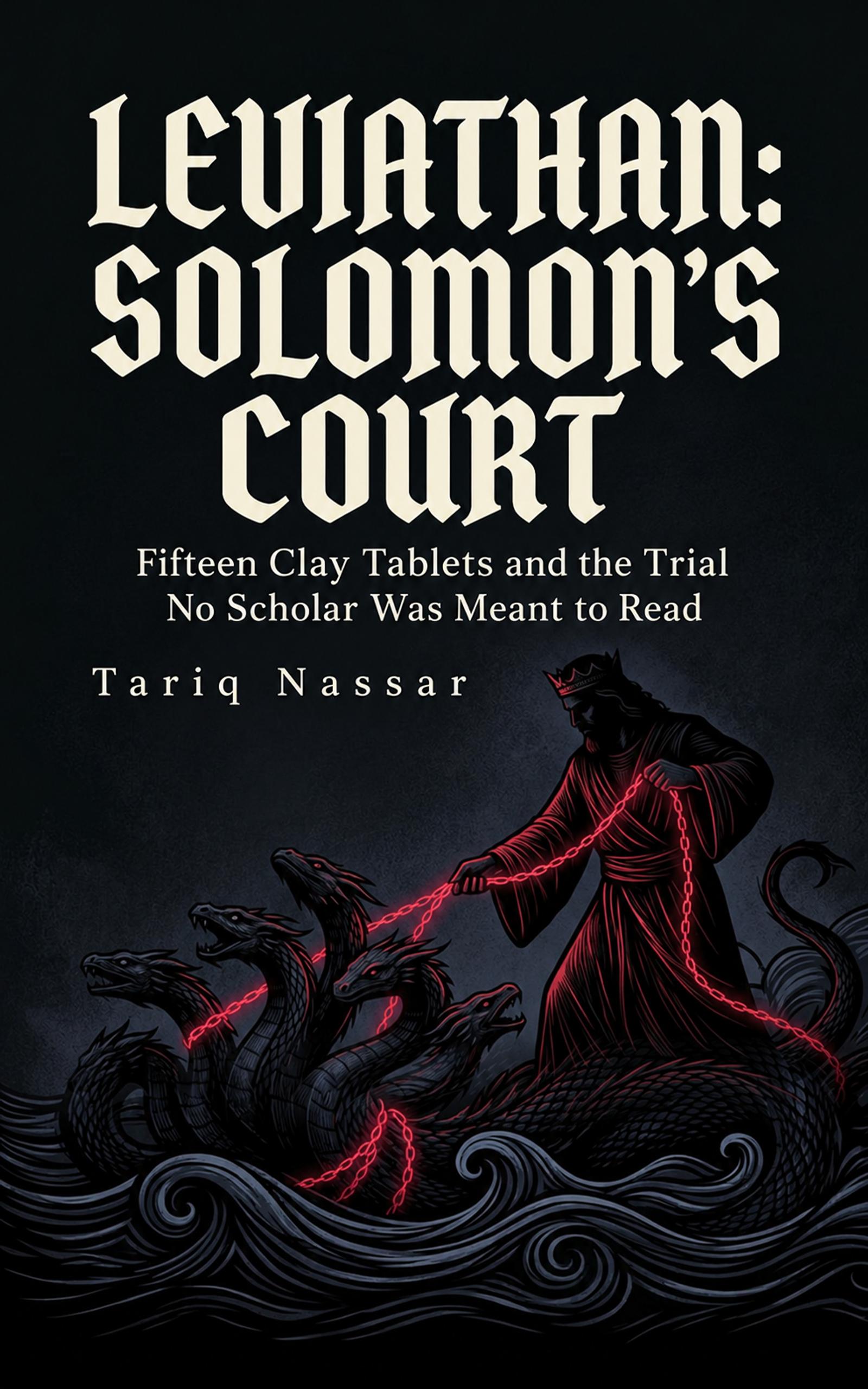
Leviathan: Solomon's Court

Author
Tariq Nassar
Share
About this book
An Israeli archaeologist translates a set of unknown Aramaic tablets unearthed beneath Jerusalem and finds herself reading the sealed terms of a treaty made at the court of King Solomon. Across two timelines — a modern translation workspace and a tenth-century BCE royal archive — Tariq Nassar's epic traces the long discharge of an ancient covenant through the patience of two scholars three thousand years apart.
Beneath the streets of Jerusalem, a sealed cache of clay tablets surfaces from a forgotten chamber, inscribed in a dialect of Aramaic no living scholar has read. Dr. Miriam Elazar, an Israeli archaeologist whose professional patience is the envy of her department, sits down to translate them.
What begins as a routine philological project — fifteen tablets, multiple angles, careful transcription — slowly reveals itself to be the record of a covenant brokered at the height of King Solomon's reign. A treaty negotiated on a coastal promontory three thousand years ago, sealed by a court scribe named Ezra, and deliberately archived so it would not be read in sequence again.
Miriam reads it in sequence. Across two timelines that share the same weight, the novel follows her work in a fluorescent-lit university room and Ezra's at the cedar-walled court that produced the document, two scholars separated by millennia and bound by the same professional ethic: the refusal to stop translating when the text becomes uncomfortable.
The terms of the covenant were specific. So is the duration. So is the manner of its discharge. Tariq Nassar's epic asks what we owe to the dead, what the dead arranged on our behalf, and whether the most admirable habit of the careful mind — finishing what it has begun — is the mechanism by which a long peace finally ends.
“A sweeping epic that earns its scale through the intimacy of its character work. Grand storytelling at its finest.”
— Anya Volkov, author of The Wild Swans★★★★☆