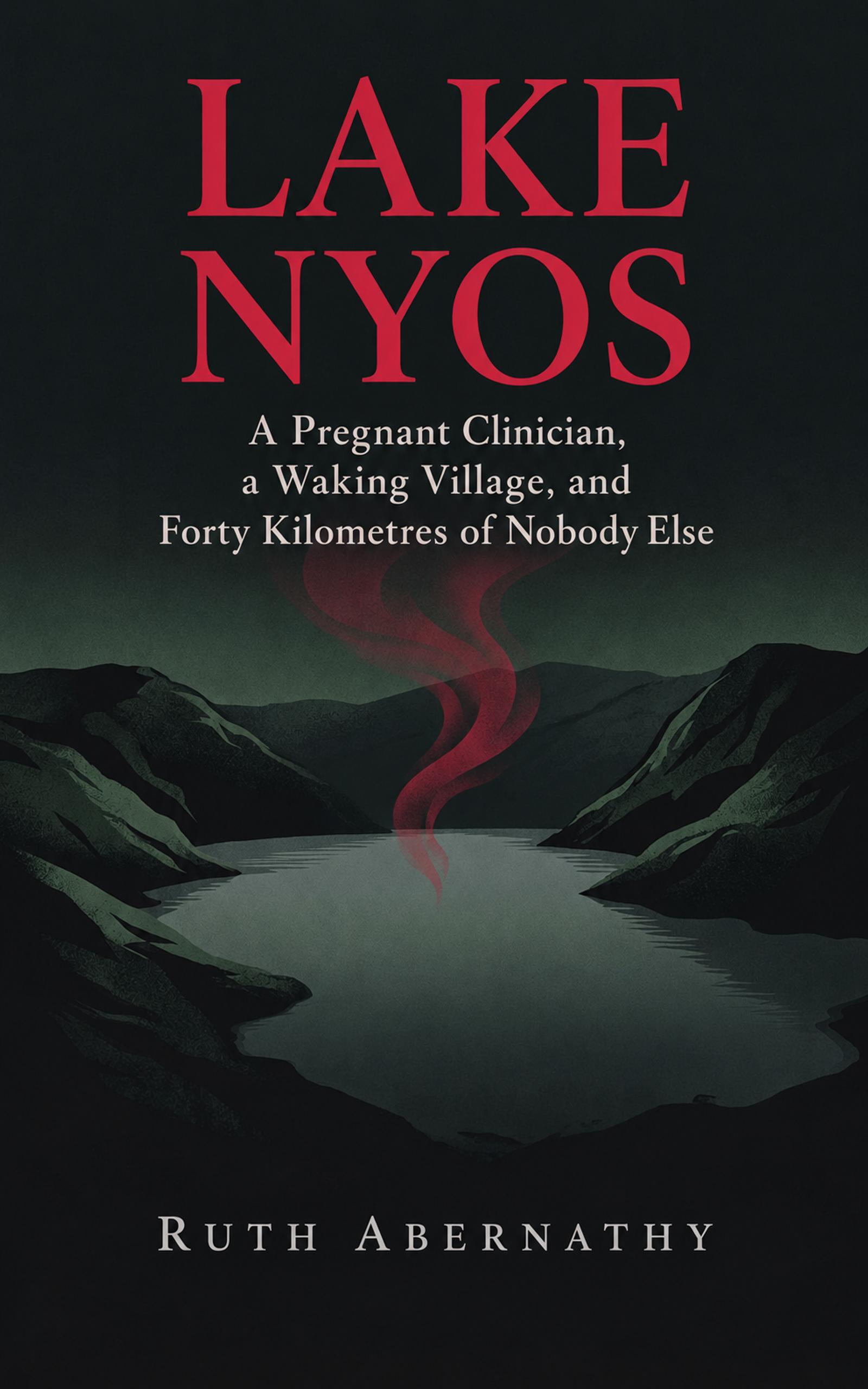
Lake Nyos

Author
Ruth Abernathy
Share
About this book
On the eve of August 21, 1986, in a farming village in Cameroon's Northwest Province, a pregnant nurse-midwife watches the volcanic lake above her community begin to behave in ways neither her medical training nor her grandmother's stories fully explain. Ruth Abernathy's debut novel braids clinical attention, ancestral memory, and the quiet pressure of geology toward catastrophe.
Before dawn, Amara Mfonte climbs the path to her clinic, seven months pregnant, the only trained medical professional within a forty-kilometre radius. Below her, the village of Nyos is waking into the rhythms it has kept for generations — roosters, mortars, women at the spring, the slow gathering of a market day in the Cameroonian highlands.
But the lake above the village has begun to change. The water has turned the colour of a bruise. Bubbles break the surface in sudden furious rings. Dead birds appear on the shore, and a sulphurous smell drifts down from the crater on certain evenings. Chief Tabah speaks of a covenant the missionaries forced the village to abandon sixty years ago, of a sleeping beast in the water. Amara's radio reaches Bamenda only in broken syllables. No one is coming.
As a young woman labours too early in her clinic and her husband puts their daughter to bed in the valley below, Amara turns over what she knows of Lake Monoun — thirty-seven dead, two years ago, sixty miles away, no explanation the government could agree on.
Ruth Abernathy's first novel renders the hours before a real catastrophe with the patience of someone counting bubbles rising through dark water. It asks what a clinician owes a community whose knowledge she has been trained to set aside, and what is owed in return.
“You know what the lake will do, and still each chapter shortens your breath; when the water finally turns, the silence afterward stays in the room with you.”
— Anneli Lindholm, author of Pebble and Stone★★★★☆