Literary FictionePub
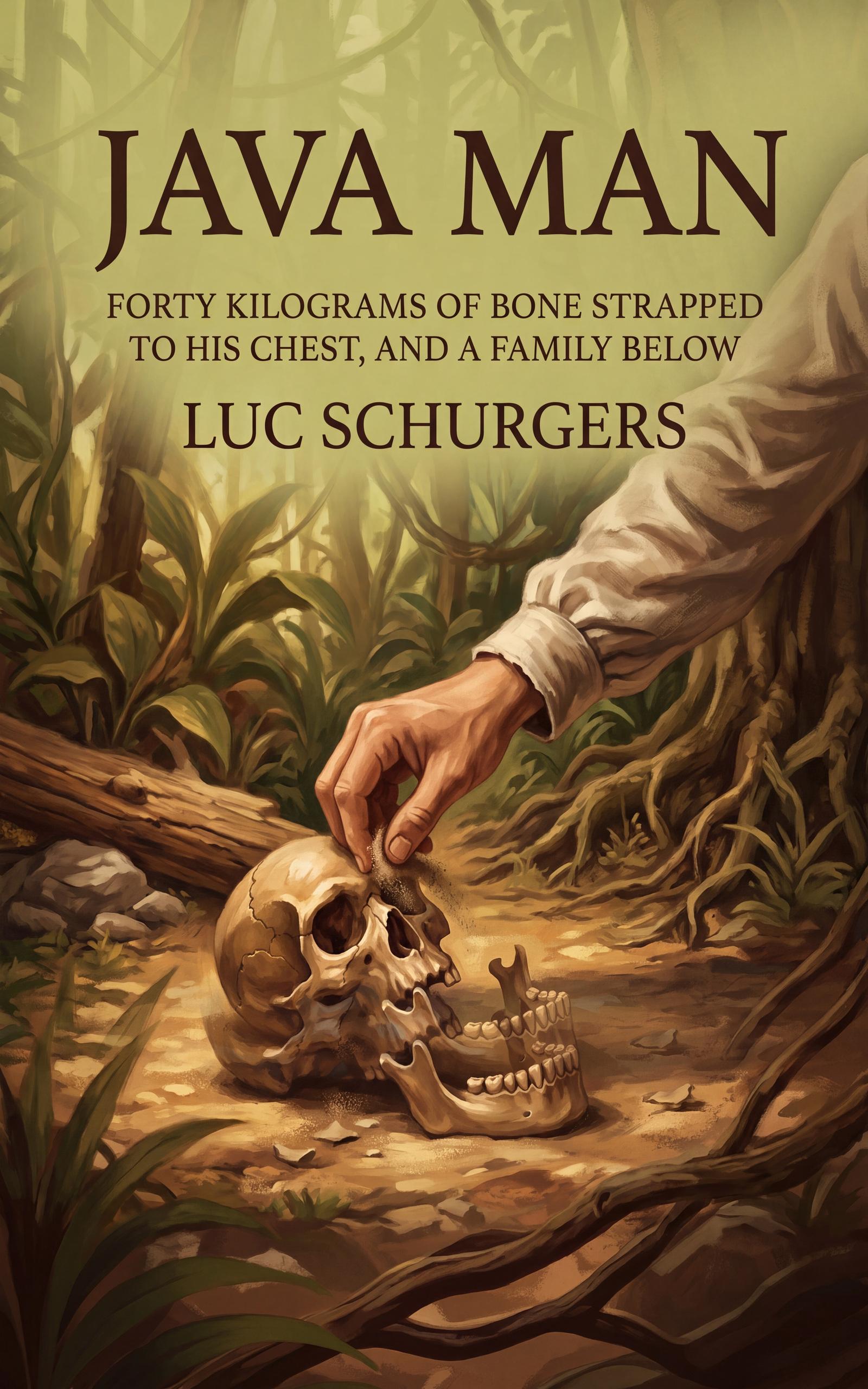
Java Man

Author
Luc Schurgers
Share
About this book
Luc Schurgers's novel follows the Dutch anatomist Eugène Dubois from an Amsterdam lecture hall to the jungles of colonial Java, where, between 1887 and 1895, he sets out to prove the existence of a creature halfway between ape and human. A study of obsession, marriage, and the human cost of certainty, set against the machinery of Dutch colonial science.
A storm in the Indian Ocean, 1895. A man stands on the listing deck of a steamer with a wooden case strapped to his chest, forty kilograms of bone and cotton wadding. Somewhere below him his wife is gathering their three children. He has chosen what he will save.
Eight years earlier, Eugène Dubois walked away from a university post in Amsterdam to chase an idea no one else believed in: that the gap between ape and human could be filled, and that he would be the one to fill it. He took his young wife Anna and their infant daughter to the Dutch East Indies, signed on as a colonial military surgeon, and put fifty convict laborers to work in the limestone caves of Sumatra and the eroding banks of the Solo River.
What he found at Trinil in 1891 — a skullcap, a tooth, a thighbone — was exactly what he had drawn in his notebook years before. The discovery did not vindicate him. It hollowed him out.
Moving from a darkened house in Haarlem in 1938 back through the monsoon years in Java, Luc Schurgers's novel asks what it costs to be right about the one thing that matters, and who pays the bill — the wife who buries a pregnancy in silence, the Javanese laborer whose hands lift the bones, the children carried into a fever country by a father already elsewhere.
“Fieldwork has rarely felt this tactile — the excavation chapters carry the damp, exact texture of jungle mud, while the marriage back home strains at the tempo of the dig.”
— Nikolai Volkov, author of Dragon Wawel★★★★★