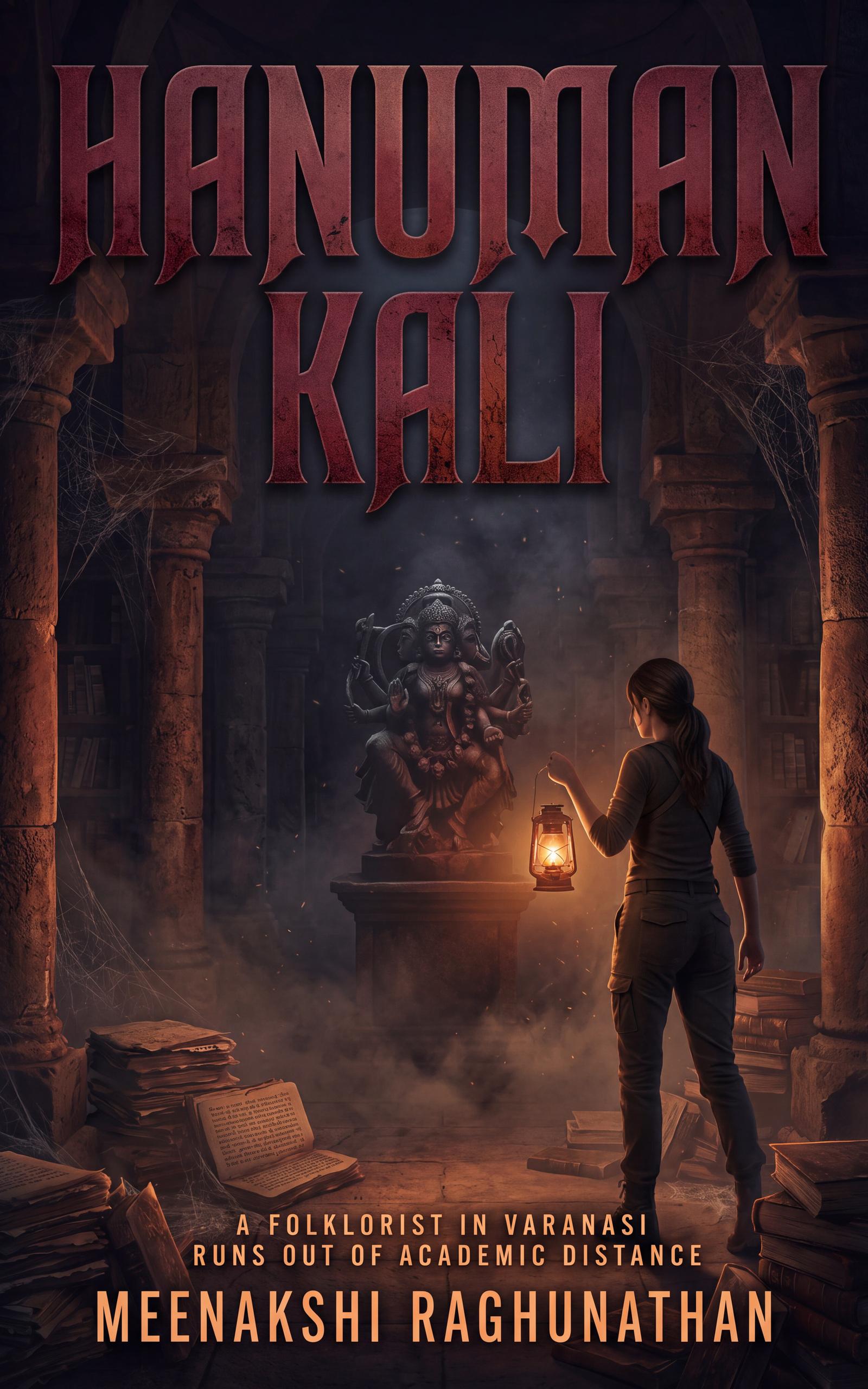
Hanuman Kali

Author
Meenakshi Raghunathan
Share
About this book
A folklore researcher at Banaras Hindu University investigates two devotional communities divided by a narrow passage of stone, where the literature of Hanuman encounters he has spent his career cataloguing begins to manifest in the bodies of his subjects — and his own. Meenakshi Raghunathan's novel of Varanasi examines scholarship, devotion, and the limits of academic distance.
On the stone ghats of Varanasi, where bathers conduct the dead with the practiced efficiency of three thousand years, Aditya Sharma walks the same paths he has walked a hundred times. A folklore researcher at Banaras Hindu University, he has built his career on academic distance — cataloguing testimonies of Hanuman encounters, mapping the patterns that recur across centuries of devotional literature.
His fieldwork brings him to two communities pressed against each other along the river: a Hanuman mandal and a small, four-hundred-year-old Kali temple, separated by a thirty-foot passage of stone. The passage is ordinary. The cold inside it is not. Among the devotees, Aditya begins to recognise the symptoms his sources describe — a young man named Rakesh whose daily practice is deepening into something the practice was never equipped to receive, a wife who watches her husband occupy a state she cannot follow him into.
Then the marks appear on Aditya's own forearm, and the encounter literature he has been studying turns its attention back on him.
What does it mean to be the witness to a tradition that has always required witnesses? Meenakshi Raghunathan's novel asks how scholarship survives the proximity of its subject — and what the body remembers when the mind insists on its distance.
“Eerie, atmospheric, and deeply affecting. The line between the living and the dead has never felt thinner.”
— Henrik Larsson, author of The Juniper Tree★★★☆☆