Literary FictionePub
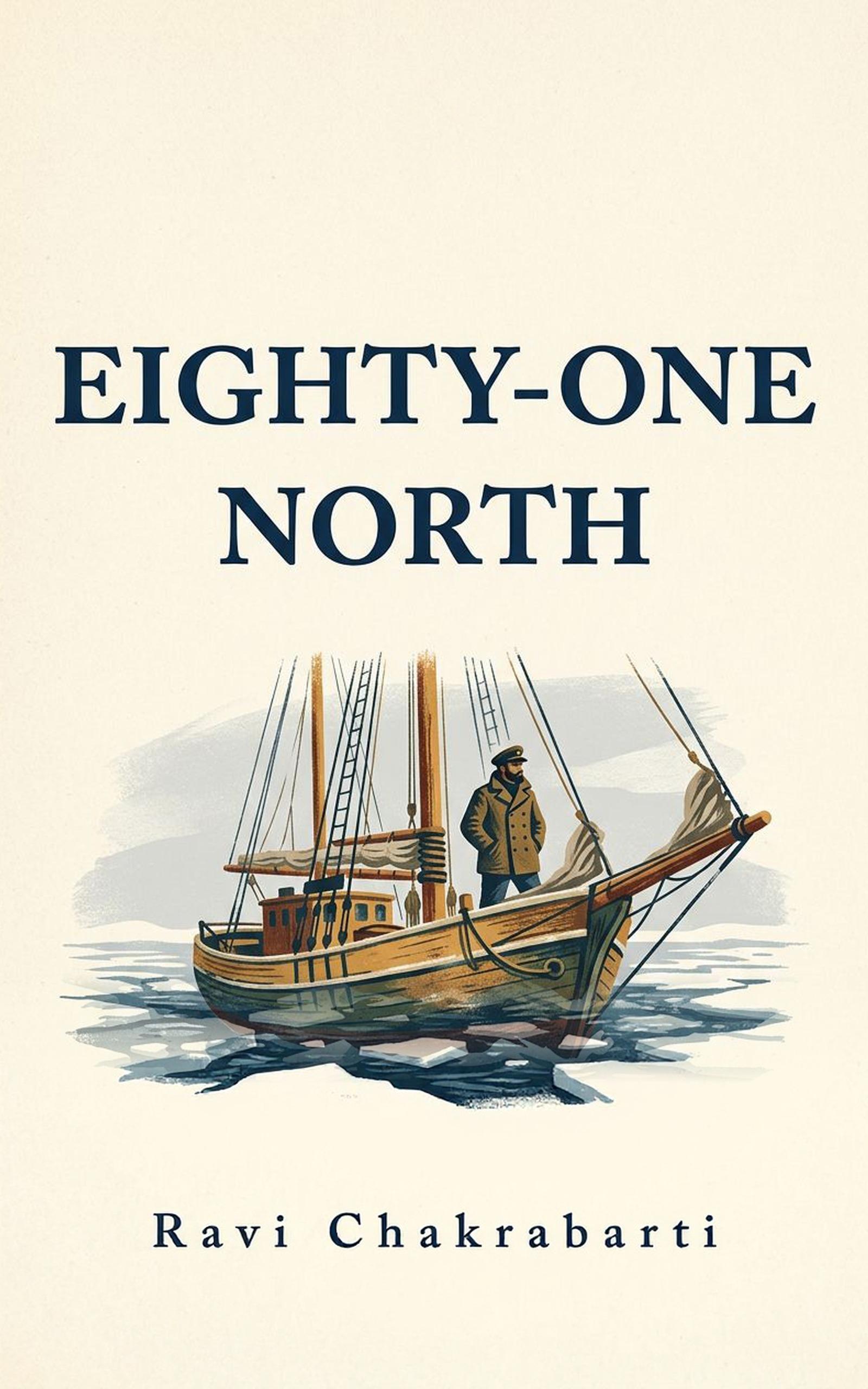
Eighty-One North

Author
Ravi Chakrabarti
Share
About this book
Russia, 1912. A fisherman's son turned naval lieutenant, refused funding by the Imperial Ministry, raises his Arctic expedition by public subscription and sails north in an ageing wooden sealer. Across two frozen winters and the slow advance of scurvy, Ravi Chakrabarti's novel traces the cost of ambition in a country that admits its outsiders only as far as service, never as far as belonging.
On a flat, mud-coloured stretch of the Sea of Azov in 1889, a fisherman's ninth son stands on the shore with a stolen geography textbook in his hands. His father, mending nets nearby, says nothing. That silence is the only permission Georgy Sedov will ever receive — and twenty-three years later, in the panelled offices of the Imperial Naval Ministry, it will not be enough.
When the admirals decline to fund his expedition to the North Pole, Lieutenant Sedov refuses to surrender the plan. He raises the money by public subscription — five rubles from a schoolchild, ten from a retired clerk — buys an ageing Norwegian sealer called the Saint Phocas, and sails from Arkhangelsk in August 1912 with seventeen men, four scientists, and coal enough only to be marginal. His wife Vera watches from the dock without waving.
What follows is two winters frozen into the ice off Novaya Zemlya and Franz Josef Land: rationed coal, blubber stoves, the abolition of sunrise, Pushkin read aloud in lamplight while the hull groans. Sedov writes letters that cannot be sent, about a kitchen window in St Petersburg that sticks.
By the second spring, scurvy has begun to dissolve him. Three days of sledging remain between his body and the Pole. Ravi Chakrabarti's novel asks what a man owes the country that will let him serve but never let him belong — and what he owes the woman waiting for a letter that will not come.
“Scurvy sets the pace here: two frozen winters told as slow accounting, where every ration and every proud decision is made to cost something.”
— Naima Beauford, author of THE ST. CROIX YEARS★★★★☆