Literary FictionePub
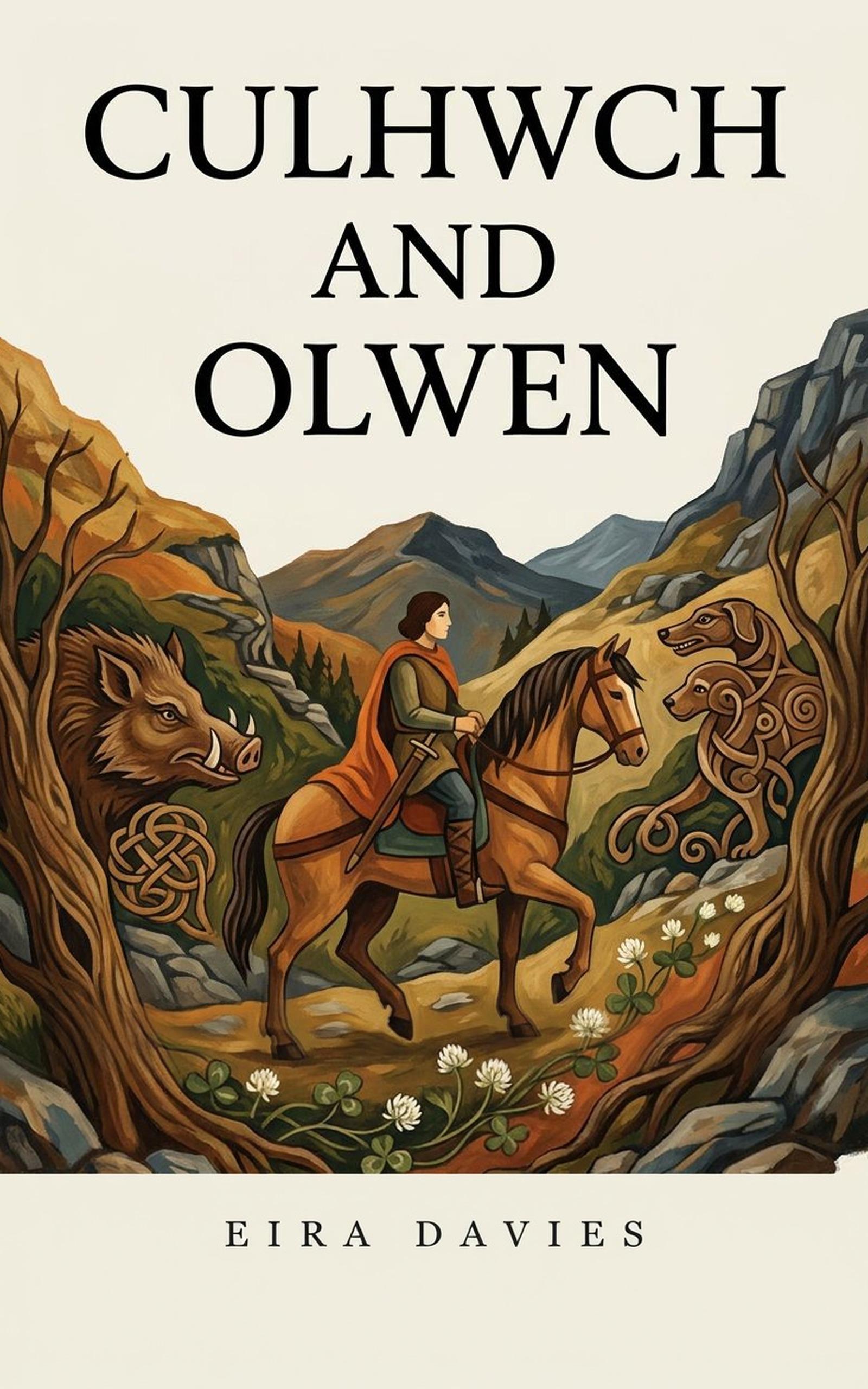
Culhwch and Olwen

Author
Eira Davies
Share
About this book
A retelling of the medieval Welsh tale from the Mabinogion, in which a young prince, cursed to love a giant's daughter, rides to the court of his cousin Arthur and gathers a company of strange companions to attempt forty impossible tasks. Eira Davies renders the quest as a painted landscape of myth, comedy, prophecy, and the price of devotion.
Rain on a Welsh hillside. A woman called Bright Day, mad with pregnancy, falls among swine and births a son in straw and mud. The boy is named for the place of his birth: Culhwch, pig's burrow. He grows golden-haired and unguarded, the kind of child whose mother is a flame-coloured memory and a lullaby half-remembered.
When his stepmother lays a curse on him — that he shall wed no woman but Olwen, daughter of Ysbaddaden Chief-Giant — Culhwch's heart belongs to a name he has never heard. He rides to his cousin Arthur's hall at Celliwig, where a broad, scarred king and his catalogue of strange companions promise him aid: the warrior who breathes fire, the man who speaks with mice, the boy hidden twenty years in a cupboard because his uncle slaughters every suitor before they can fulfil the prophecy that his daughter's marriage will mean his death.
Forty impossible tasks stand between Culhwch and Olwen. A self-playing harp. A cauldron at the world's edge. A boar bearing comb and razor between its ears. And Olwen herself, white trefoils blooming where she walks, asking the question no curse can answer: what does it mean to choose someone, when your father must die for the choosing?
Eira Davies retells the oldest Arthurian tale in painted, watercolour Wales — a quest in which the loveliness of the world and the cost of love are inseparable.
“A scribe's patience catalogues the forty impossible tasks; comic timing undercuts them by the syllable. This retelling trusts the old tale's architecture and contents itself with repainting the walls.”
— Petr Havlík, author of The Lightning Bird★★★★☆